Droven.io AI Career Roadmap: How to Plan Your Future in Artificial Intelligence
Artificial intelligence is no longer a niche field reserved for researchers and advanced programmers. It is becoming part of software development. more..
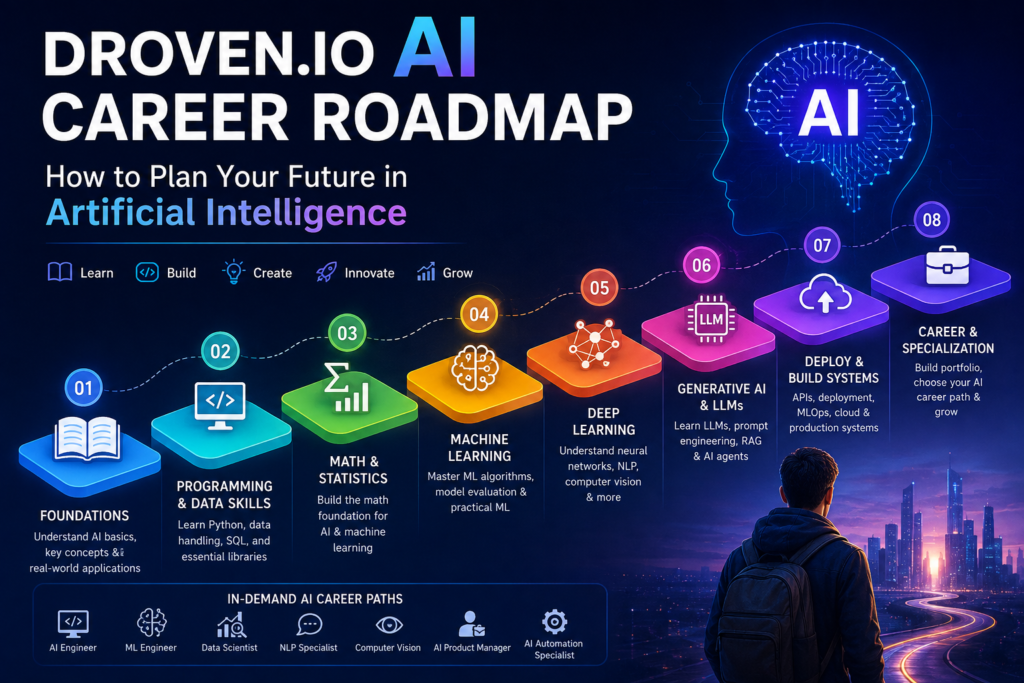
Artificial intelligence is no longer a niche field reserved for researchers and advanced programmers. It is becoming part of software development, business operations, marketing, finance, healthcare, education, cybersecurity, and countless other industries. As a result, more students, professionals, freelancers, and career switchers are asking the same question: How do I build a career in AI without wasting years learning the wrong things?
That is where a structured AI career roadmap can help.
The Droven.io AI Career Roadmap is best approached as a structured learning and career-planning framework: start with fundamentals, develop technical and data skills, learn machine learning, move into modern generative AI, build practical projects, choose a specialization, and then turn those skills into demonstrable career value. Current discussions around AI career planning similarly emphasize programming, data literacy, machine learning, LLM applications, deployment, projects, and specialization.
One important point is worth making upfront: publicly available information does not clearly establish Droven.io as a verified educational institution or credential provider. Therefore, the roadmap is more useful when treated as a practical sequence of skills and career milestones, rather than as a formal qualification or guarantee of employment.
What Is the Droven.io AI Career Roadmap?
An AI career roadmap is essentially a plan that tells you what to learn, when to learn it, and how to apply it.
Without a roadmap, beginners often jump between unrelated subjects. One week they study Python, the next they experiment with an AI chatbot, then they hear that prompt engineering is the future and abandon everything else.
That approach creates exposure without depth.
A structured path works differently. You first develop a foundation, then gradually add technical skills, machine learning knowledge, modern AI capabilities, and real-world experience.
The roadmap can therefore be viewed as a progression:
- Understand AI fundamentals.
- Learn programming and data skills.
- Build mathematics and statistics knowledge.
- Study machine learning.
- Move into deep learning.
- Learn generative AI and LLM applications.
- Understand deployment and practical AI systems.
- Build projects and a portfolio.
- Select a career specialization.
- Prepare for the job market.
The exact order can be adjusted depending on your background. A software developer, for example, may move through programming fundamentals much faster than someone who has never coded.
Who Should Follow an AI Career Roadmap?
The roadmap is not limited to computer science graduates.
Complete Beginners
If you have never worked with AI or programming, the roadmap gives you a logical starting point. You do not need to understand neural networks on day one.
Your first objective should simply be to understand what AI is, how machine learning differs from traditional programming, and where these technologies are used.
Students and Recent Graduates
Students can use an AI roadmap to supplement formal education with practical skills.
University coursework may provide theory, but employers often want evidence that you can actually build something. Projects, GitHub repositories, internships, competitions, and practical experimentation can help bridge that gap.
Software Developers
Developers already have a major advantage because programming is central to many AI roles.
Instead of spending months learning basic coding, developers can focus on data processing, machine learning concepts, model integration, APIs, LLM applications, deployment, and system design.
Data Professionals
People working with spreadsheets, databases, analytics, or business intelligence already possess useful skills.
For them, machine learning, statistics, Python, and AI-assisted analytics can provide a natural transition into more advanced AI-related work.
Career Switchers
Career switching into AI is possible, but the smartest approach is usually to combine your existing industry knowledge with new AI skills.
For example, someone with marketing experience could explore AI marketing automation, while an operations professional might specialize in AI workflow automation.
The best roadmap starts with where you are now, rather than pretending every learner has the same background. Current AI career guidance increasingly emphasizes this background-specific approach.
Stage 1: Build Your Artificial Intelligence Foundations
Before learning complicated frameworks, understand the basic language of AI.
You should know the difference between:
- Artificial intelligence
- Machine learning
- Deep learning
- Generative AI
- Natural language processing
- Computer vision
- Predictive analytics
- AI automation
- AI agents
You do not need to become an expert at this stage.
The goal is to understand what each technology does and when it is appropriate.
For example, a recommendation engine that predicts what a customer may want is fundamentally different from a generative AI system that creates text. Similarly, an automated workflow that uses an existing AI API is different from training a machine learning model from scratch.
Understanding these distinctions will make later career decisions much easier.
Learn How AI Systems Actually Work
Start learning concepts such as:
- Training data
- Features
- Models
- Training
- Inference
- Predictions
- Parameters
- Evaluation
- Bias
- Accuracy
- Overfitting
You should eventually be able to explain these concepts in simple language.
That ability is more valuable than memorizing technical definitions without understanding them.
Stage 2: Learn Python, Programming, and Data Skills
For many technical AI careers, Python is the most practical programming language to learn first.
You do not need to become a software architect before starting machine learning. However, you should be comfortable enough with Python to write, read, modify, and debug basic programs.
Python Skills to Learn
Focus on:
- Variables and data types
- Conditional statements
- Loops
- Functions
- Lists and dictionaries
- File handling
- Modules
- Object-oriented programming
- Error handling
- Basic debugging
Once you have the basics, start working with libraries commonly used in data and AI workflows.
Learn Data Handling
AI depends heavily on data.
That makes data literacy one of the most important foundations in the entire roadmap.
Learn how to:
- Load datasets
- Clean missing data
- Remove duplicates
- Transform columns
- Explore patterns
- Visualize information
- Prepare data for models
Python libraries such as Pandas and NumPy are useful here, while SQL becomes increasingly important when working with databases.
Learn Git and GitHub
Do not wait until you are job hunting to learn version control.
Git and GitHub can become part of your learning process from the beginning. Every meaningful project you build can eventually become part of your professional portfolio.
Stage 3: Learn the Mathematics and Statistics Behind AI
Mathematics often intimidates beginners.
The good news is that you do not need to become a mathematician before beginning your AI journey.
You need enough mathematical understanding to know why models behave the way they do.
Focus on Linear Algebra
Understand concepts such as:
- Vectors
- Matrices
- Matrix operations
- Dimensions
- Dot products
These concepts become increasingly relevant as you study machine learning and neural networks.
Learn Probability and Statistics
Statistics is particularly useful for understanding data and evaluating models.
Focus on:
- Mean and median
- Variance and standard deviation
- Probability
- Distributions
- Correlation
- Sampling
- Confidence intervals
- Basic hypothesis testing
Understand Basic Calculus
For deeper machine learning and neural network work, concepts such as derivatives and gradients become useful.
You do not necessarily need to perform complicated calculations by hand. Instead, understand what optimization is doing and why gradients matter.
The objective is practical understanding, not mathematical perfection.
Stage 4: Master Machine Learning Fundamentals
This is where your roadmap moves from general AI knowledge into actual model development.
Machine learning teaches computers to identify patterns in data and use those patterns to make predictions or decisions.
Learn Supervised Learning
Start with algorithms such as:
- Linear regression
- Logistic regression
- Decision trees
- Random forests
- Support vector machines
- Basic ensemble methods
Understand not only how to run them, but also when and why you would use them.
Learn Unsupervised Learning
Explore:
- Clustering
- Dimensionality reduction
- Pattern discovery
These techniques help you understand data when you do not have clearly labeled outcomes.
Understand Model Evaluation
A model producing predictions is not automatically a good model.
Learn about:
- Training and testing datasets
- Validation
- Accuracy
- Precision
- Recall
- F1 score
- Mean squared error
- Confusion matrices
- Cross-validation
Also understand overfitting and underfitting.
These concepts are important because employers need AI professionals who can diagnose problems rather than simply run a library.
Start With Practical Machine Learning
Scikit-learn is a useful starting point for experimenting with traditional machine learning.
Build small models before moving to complex neural networks.
That progression gives you a better understanding of what modern AI frameworks are actually doing underneath the surface.
Stage 5: Move Into Deep Learning
Once you understand traditional machine learning, you can begin exploring deep learning.
Deep learning uses neural networks with multiple layers to learn increasingly complex patterns.
Learn Neural Network Fundamentals
Understand:
- Neurons
- Layers
- Activation functions
- Loss functions
- Backpropagation
- Gradient descent
- Training epochs
- Batch size
You do not need to memorize every neural network architecture.
Focus first on understanding the basic mechanism.
Explore Computer Vision
If you are interested in images and video, learn about:
- Image classification
- Object detection
- Image preprocessing
- Convolutional neural networks
Explore Natural Language Processing
For language-focused careers, study:
- Text classification
- Tokenization
- Embeddings
- Language models
- Transformer architectures
Frameworks such as PyTorch and TensorFlow can become useful as your projects become more advanced.
Stage 6: Learn Generative AI, LLMs, and AI Agents
A modern AI career roadmap cannot stop at traditional machine learning.
Generative AI has changed how businesses build and use AI systems, and current AI learning paths increasingly include LLM applications, RAG, evaluation, APIs, and AI agents.
Understand Large Language Models
Learn what LLMs are designed to do and how they process language.
You should understand concepts including:
- Tokens
- Context windows
- Embeddings
- Model inference
- Fine-tuning
- Temperature
- Structured outputs
Learn Prompt Engineering
Prompting is useful, but it should not become your entire AI education.
Learn how to:
- Give clear instructions
- Provide context
- Define output formats
- Use examples
- Break complex tasks into steps
- Evaluate generated responses
Prompting becomes much more powerful when combined with programming and domain expertise.
Build LLM Applications
Move beyond simply chatting with AI tools.
Learn how to connect models to applications using APIs.
Possible projects include:
- Document summarizers
- Customer-support assistants
- Research tools
- Content classification systems
- Knowledge-base chatbots
- Internal business assistants
Understand RAG
Retrieval-augmented generation allows AI applications to retrieve relevant information before generating an answer.
Learn the basic architecture:
User question → retrieval → relevant information → LLM → response
You should also understand why retrieval quality and evaluation matter.
Explore AI Agents
AI agents can combine language models with tools, APIs, workflows, and external information.
Learn concepts such as:
- Tool calling
- Workflow orchestration
- Agent memory
- Human approval
- Guardrails
- Evaluation
The goal should not be to build the most complicated agent possible.
Instead, learn how to create reliable systems that solve useful problems.
Stage 7: Learn the Tools and Technologies Used in AI
Learning AI concepts is only one part of becoming employable.
You also need to understand the practical technology stack used to build, test, deploy, and maintain AI systems.
Core Tools to Consider
A useful learning stack can include:
| Area | Technologies to Explore |
|---|---|
| Programming | Python |
| Data | Pandas, NumPy, SQL |
| Machine Learning | Scikit-learn |
| Deep Learning | PyTorch, TensorFlow |
| Development | Jupyter, VS Code |
| Version Control | Git, GitHub |
| LLM Applications | AI APIs, embeddings, RAG |
| Databases | SQL and vector databases |
| Cloud | AWS, Azure, Google Cloud |
| Deployment | APIs, containers, cloud services |
You do not need to master every technology listed above.
Choose tools according to your target career.
A data scientist and an AI automation specialist do not need identical technology stacks.
Stage 8: Build Real AI Projects and a Strong Portfolio
This may be the most important stage of the entire roadmap.
Courses can demonstrate that you studied something.
Projects demonstrate that you can use it.
Start With Small Projects
Beginners can build projects such as:
- House price prediction
- Spam detection
- Sentiment analysis
- Customer segmentation
- Recommendation systems
- Simple image classifiers
The purpose is to practice the complete process from data collection to evaluation.
Move Toward More Advanced Projects
Once you become comfortable, build:
- RAG applications
- AI document assistants
- Recommendation engines
- AI workflow automation
- LLM-powered research tools
- Computer vision applications
- Predictive business models
The project should solve a real problem whenever possible.
Make Your GitHub Portfolio Professional
Every serious project should explain:
- What problem you solved
- Why the problem matters
- What data you used
- Which technologies you selected
- How the system works
- What results you achieved
- What limitations exist
- What you would improve next
Do not simply upload code and call it a portfolio.
Employers should be able to understand your thinking.
AI Portfolio Checklist
- Build 3–5 meaningful projects
- Publish projects on GitHub
- Write clear README files
- Explain technical decisions
- Include results and evaluation
- Add demonstrations where possible
- Document limitations
- Connect at least one project to a real-world problem
Stage 9: Choose Your AI Career Specialization
You do not need to master every branch of AI.
Once your foundation is strong enough, choose a direction.
AI Engineer
AI engineers generally focus on building and integrating AI-powered applications.
This path can involve programming, APIs, LLMs, deployment, databases, and system architecture.
Machine Learning Engineer
This is a more technically intensive path involving model development, data pipelines, deployment, monitoring, and production machine learning systems.
Data Scientist
Data scientists combine statistics, programming, data analysis, and machine learning to solve business problems.
NLP or LLM Specialist
This path focuses on language technologies, LLM applications, retrieval systems, evaluation, and related natural-language systems.
Computer Vision Engineer
This is suitable for people interested in images, video, object detection, medical imaging, robotics, and visual AI.
AI Automation Specialist
This can be an attractive direction for people who want to connect AI with business workflows.
The work may involve APIs, AI models, automation platforms, business processes, and human approval systems.
AI Product Manager
Not every AI career requires deep model-building expertise.
AI product managers need to understand technology well enough to work with engineers while also understanding users, business goals, product strategy, and risk.
AI Governance and Safety
Organizations also need professionals who understand AI risk, documentation, privacy, compliance, evaluation, and responsible deployment.
How to Choose the Right AI Career Path
Use your existing strengths as a starting point.
| Your Background | AI Direction to Explore | Main Skills |
|---|---|---|
| Beginner | AI applications / automation | AI literacy, tools, basic coding |
| Software developer | AI Engineer / ML Engineer | Python, ML, APIs, deployment |
| Data analyst | Data Science / AI Analytics | SQL, Python, statistics, ML |
| Marketing | AI Marketing / Automation | AI tools, analytics, automation |
| Operations | AI Automation | Workflows, APIs, process design |
| Product | AI Product Management | AI concepts, product strategy |
| Research-oriented | AI Research | Mathematics, ML, deep learning |
The important lesson is that your previous career is not necessarily something you have to abandon.
It can become your competitive advantage.
How Long Does the Droven.io AI Career Roadmap Take?
There is no universal timeline.
Someone studying AI for 20 hours every week will progress differently from someone studying five hours on weekends.
A realistic progression could look like this:
First 3 Months
Focus on:
- AI fundamentals
- Python
- Data handling
- SQL basics
- Basic mathematics
- Small projects
Months 4–6
Move into:
- Machine learning
- Model evaluation
- Scikit-learn
- Intermediate projects
- GitHub portfolio development
Months 7–9
Explore:
- Deep learning
- PyTorch or TensorFlow
- NLP or computer vision
- Generative AI
- LLM APIs
Months 10–12
Focus on:
- RAG
- AI agents
- Deployment
- Advanced portfolio projects
- Specialization
- Job preparation
This does not mean you must wait 12 months before applying for opportunities.
If you already have professional experience, you may be able to start applying much sooner for roles that combine your existing expertise with AI.
How to Turn AI Skills Into a Career
Learning is only half of the process.
At some point, you need to demonstrate your abilities to employers or clients.
Build an AI-Focused Resume
Your resume should emphasize outcomes rather than simply listing technologies.
Instead of writing:
“Learned Python and machine learning.”
A stronger project description might explain what you built, what data it used, which techniques you applied, and what result you achieved.
Optimize Your LinkedIn Profile
Make your target direction clear.
If you want to become an AI engineer, your profile should not present you as someone who is interested in ten unrelated careers.
Pick a direction.
Use GitHub as Evidence
A strong GitHub profile can reinforce your resume.
Focus on quality rather than quantity.
Five thoughtful projects are usually more useful than dozens of unfinished repositories.
Prepare for AI Interviews
Depending on the position, expect questions about:
- Python
- SQL
- Machine learning
- Statistics
- Model evaluation
- Data preprocessing
- LLM applications
- System design
- Your own projects
You should be able to explain every important part of your portfolio.
Common Mistakes to Avoid
AI learners frequently make the same mistakes.
Trying to Learn Everything
AI is too broad to master all at once.
Choose a sequence.
Jumping Straight Into Prompt Engineering
Prompting is useful, but it is not a substitute for understanding data, programming, AI systems, and evaluation.
Collecting Courses Instead of Building Projects
Watching tutorials can feel productive while producing very little evidence of ability.
Build as you learn.
Chasing Every New AI Tool
The AI ecosystem changes rapidly.
Do not rebuild your career plan every time a new tool appears.
Learn durable concepts first, then adopt useful tools.
Ignoring Communication Skills
Technical ability alone is not enough for many professional roles.
AI professionals need to explain ideas, document systems, communicate limitations, and work with people from different departments.
Expecting Immediate High-Paying Jobs
An AI roadmap can improve your direction, but it does not guarantee employment.
Career progression depends on skills, experience, portfolio quality, location, industry, networking, interviewing, and the specific role.
How to Keep Your AI Career Future-Ready
The roadmap should not end when you get your first AI job.
Artificial intelligence will continue changing.
The most valuable long-term skill may therefore be the ability to keep learning without constantly starting over.
Focus on Durable Skills
Prioritize:
- Programming
- Data literacy
- Problem-solving
- Statistics
- Machine learning fundamentals
- System design
- Evaluation
- Communication
- Domain knowledge
Tools will change.
These underlying skills remain useful.
Combine AI With Domain Expertise
AI becomes particularly valuable when combined with knowledge of a specific industry.
Finance + AI.
Marketing + AI.
Healthcare + AI.
Cybersecurity + AI.
Education + AI.
Operations + AI.
This combination can create career opportunities that pure technical knowledge alone may not provide.
Learn to Evaluate AI Systems
As AI becomes easier to build, reliability becomes more important.
Learn how to ask:
- Is the output accurate?
- Can the result be reproduced?
- What happens when the model fails?
- Is sensitive information protected?
- Does the system require human review?
- How should performance be measured?
Building AI is important.
Building reliable AI is even more valuable.
Final Thoughts
The Droven.io AI Career Roadmap should not be viewed as a shortcut into artificial intelligence.
It is better understood as a structured way to organize a complicated field.
Start with fundamentals. Learn Python and data skills. Develop enough mathematics and statistics to understand machine learning. Build traditional ML knowledge before moving into deep learning and modern generative AI. Then create real projects, publish your work, choose a specialization, and connect your skills to actual career opportunities.
Modern AI career planning also needs to go beyond traditional machine learning. LLM applications, retrieval-augmented generation, AI agents, evaluation, deployment, and responsible AI are increasingly important parts of the ecosystem.
Most importantly, do not try to learn everything simultaneously.
Pick the next skill.
Build something with it.
Then move forward.
That simple cycle—learn, build, document, specialize, and improve—is far more sustainable than endlessly collecting courses or chasing every new AI trend.
Frequently Asked Questions
Is the Droven.io AI Career Roadmap suitable for complete beginners?
Yes. A structured roadmap can be useful for beginners because it gives them an order for learning instead of forcing them to navigate the entire AI ecosystem at once. Start with AI fundamentals, basic programming, and data skills before moving into advanced machine learning.
Do I need a computer science degree to start an AI career?
No. A computer science degree can provide a strong foundation, but it is not the only route into AI. Self-learning, projects, professional experience, and specialized training can also help. The appropriate path depends heavily on the AI role you want.
How long does it take to become job-ready in AI?
There is no fixed answer. A learner studying consistently may develop a useful foundation within several months, while becoming competitive for advanced engineering or research roles can take substantially longer.
Should I learn Python before machine learning?
For most technical AI paths, yes. Python makes it easier to work with data, machine learning libraries, APIs, and AI frameworks.
How much mathematics do I need for artificial intelligence?
You need more mathematics for research-heavy and advanced machine learning roles than for many AI application or automation roles. Start with basic statistics, probability, linear algebra, and the calculus concepts relevant to optimization.
Should I learn machine learning or generative AI first?
For a long-term technical career, learning machine learning fundamentals before going deeply into generative AI is generally useful. However, beginners can experiment with generative AI tools early while continuing to build their technical foundation.
Is prompt engineering enough to build an AI career?
Usually not by itself. Prompting is a useful skill, but stronger career opportunities generally come from combining it with programming, data knowledge, domain expertise, AI application development, evaluation, or automation.
What AI projects should beginners put in their portfolios?
Start with projects that demonstrate progression. Examples include a prediction model, classification project, sentiment analyzer, recommendation system, document assistant, RAG chatbot, or AI automation workflow.
Can someone without coding experience work in AI?
Yes, particularly in hybrid roles involving AI operations, automation, product management, consulting, analytics, governance, or business implementation. However, technical AI engineering roles generally require stronger programming skills.
Are AI certifications worth getting?
Certifications can supplement a portfolio, especially when they demonstrate knowledge of a recognized technology or platform. They should not replace practical projects and demonstrable skills.
What is the best AI career path for software developers?
AI engineering, machine learning engineering, LLM application development, and AI-focused software engineering are natural options. Developers can leverage their existing programming and system-design experience while adding machine learning and AI-specific knowledge.
How do I know when I am ready to apply for AI jobs?
You are in a stronger position when you can independently build relevant projects, explain your technical decisions, discuss limitations, use your chosen tools comfortably, and demonstrate your work through a professional portfolio.
What is the most important part of an AI career roadmap?
Consistency is more important than trying to learn everything.
A strong roadmap gives you direction, but your progress comes from repeatedly turning knowledge into practical work.